Donald Trump and the "Oil Weapon": A Fiery Deterrence Strategy in the Middle East
Donald Trump and the "Oil Weapon": A Fiery Deterrence Strategy in the Middle East
The global energy market in early 2026 is currently experiencing a level of volatility unseen in modern geopolitical history. As the military confrontation between the United States and Iran—codenamed "Operation Epic Fury"—reaches its most critical juncture, President Donald Trump has fundamentally altered the rules of engagement. By positioning oil not merely as a commodity, but as a strategic "trump card," Trump is leveraging the global dependency on energy to dismantle the regional power structure of the Middle East. His recent rhetoric represents more than standard military posturing; it is the emergence of a ruthless, new economic doctrine.
The "20 Times" Doctrine: Maximum Deterrence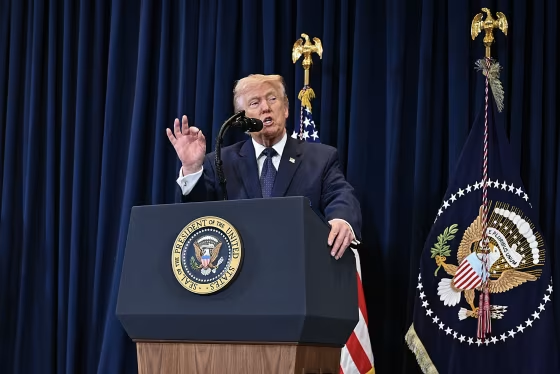
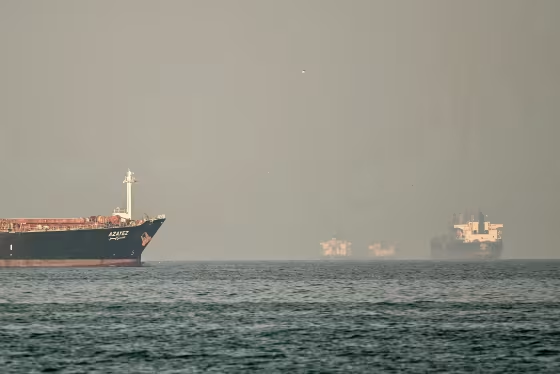
The flashpoint emerged when the Islamic Revolutionary Guard Corps (IRGC) signaled potential intentions to blockade the Strait of Hormuz, the world’s most critical maritime chokepoint through which approximately 20% of global oil flows. Trump’s reaction on Truth Social was swift and uncompromising.
He warned that any obstruction of this vital artery would trigger a U.S. response "20 times" more severe than any previous conflict. This numerical threshold was a deliberate signal to Tehran: Washington is prepared to permanently erase Iran’s industrial infrastructure. To Trump, securing the Strait is not merely an economic duty; he views it as a humanitarian "gift of peace" that the United States provides to the global community, even extending that protection to strategic rivals like China.
"Death, Fire, and Fury": The Targeting of Economic Hubs
A defining characteristic of Trump’s 2026 approach is the explicit abandonment of the traditional separation between military and economic targets. Previous administrations often avoided direct hits on energy infrastructure to minimize global price spikes. Trump, conversely, has placed Iran’s oil heartland—specifically the export hubs on Kharg Island—firmly in his crosshairs.
By invoking his trademark "Death, Fire, and Fury" rhetoric, Trump has set a terrifying expectation: should Iran attempt to turn off the oil tap, it would be an act of "economic suicide." His objective is to ensure that any aggression from Tehran is met with such overwhelming force that the nation’s ability to participate in the global energy market is severed for decades.
The $100 Oil Dilemma: Prioritizing Geopolitics Over the Pump
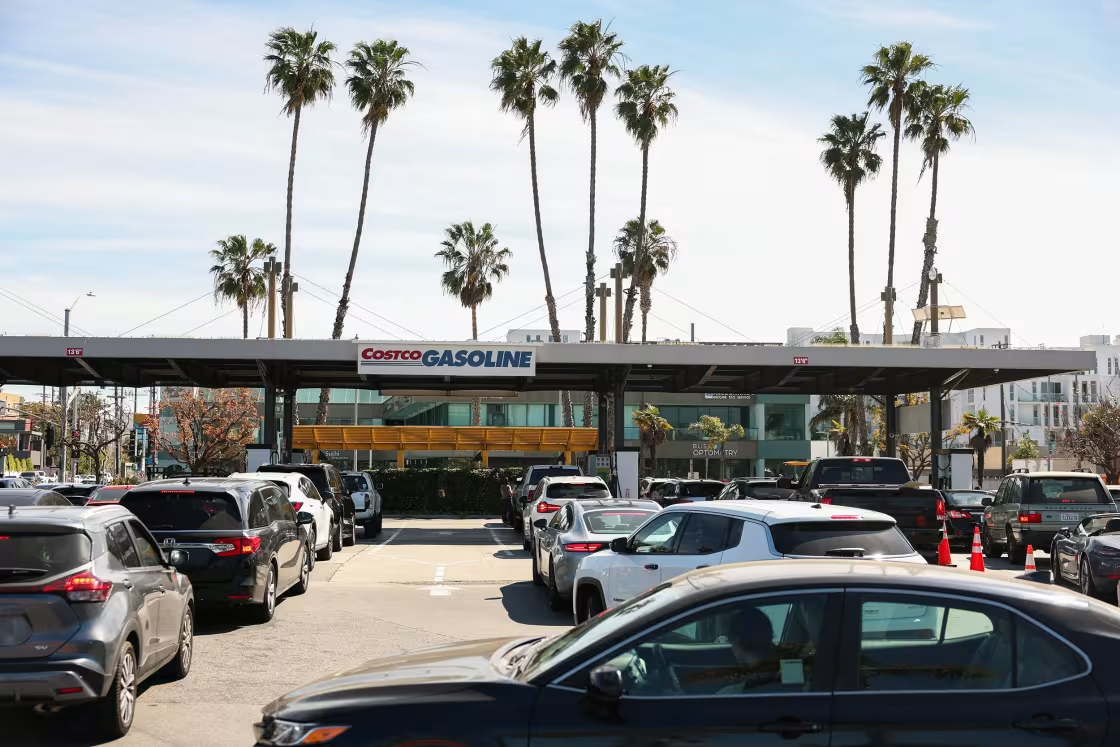
The surge of Brent crude past $119 per barrel in March 2026 created a difficult domestic challenge. As American voters faced record-high costs at the pump, critics expected the President to push for lower prices. Instead, Trump adopted a defiant stance, labeling high gas costs as a "very small price to pay for national safety."
This bold prioritization of national security over short-term political convenience is a cornerstone of his 2026 strategy. He is gambling that the American electorate will support a higher cost of living if it results in the permanent neutralization of a perceived geopolitical threat. To mitigate market panic, however, he has introduced a "flexibility mechanism," hinting at the targeted easing of sanctions on other nations to prevent a total supply collapse.
Architecting a New Energy Hegemony
Trump’s declarations are clearly aimed at a fundamental "energy pivot." By threatening the destruction of the Iranian oil industry, he is simultaneously incentivizing American energy firms to pursue his "Drill, Baby, Drill" initiative with renewed intensity.
His vision is to replace the supply void left by Iranian oil with American production. By achieving total energy dominance, Trump intends to render the blackmail tactics of "hostile" nations obsolete, effectively stripping Iran of its most potent economic lever in the Middle East.
The Red Line and the Paradox of Survival
Following the neutralization of key Iranian military leadership in late February, the international community has been waiting to see if the rhetoric would translate into the destruction of Iran’s oil fields. While the war is being framed as "virtually complete," the persistent presence of U.S. aircraft carriers in the Persian Gulf acts as a constant, lethal reminder.
Tehran now faces a harrowing paradox: if they fulfill their threat to block oil, they face total destruction; if they remain passive, their economy remains under a strangling sanctions regime.
Conclusion
The statements made by Donald Trump in 2026 are far more than digital bluster; they are the foundation of a "maximum pressure" strategy that fuses brute military force with hard-nosed economic arithmetic. By transforming oil into a central battlefield, Trump has issued a singular, unmistakable warning to the world: any actor that threatens global energy security will face a level of retaliation that is effectively limitless. As the world watches, it is clear that the global economy is now inextricably linked to the unpredictable trajectory of a conflict that could, at any moment, transform a peaceful trade route into a theater of fire and steel.
Trump repeated that message later in the day at a Florida press conference, where he said the U.S. is "achieving major strides toward completing our military objectives."
"This was just an excursion into something that had to be done," Trump said. "We’re getting very close to finishing that, too."
Comments (0)
Loading comments...