Reports circulating across international media and social platforms claim that Germany, Sweden, and Norway are preparing to send troops to Greenland, allegedly in response to renewed discussions around former U.S. President Donald Trump’s past threats to annex the strategically vital Arctic island. While official confirmation remains limited, the situation has reignited global debate about Arctic security, NATO cooperation, and the geopolitical importance of Greenland.
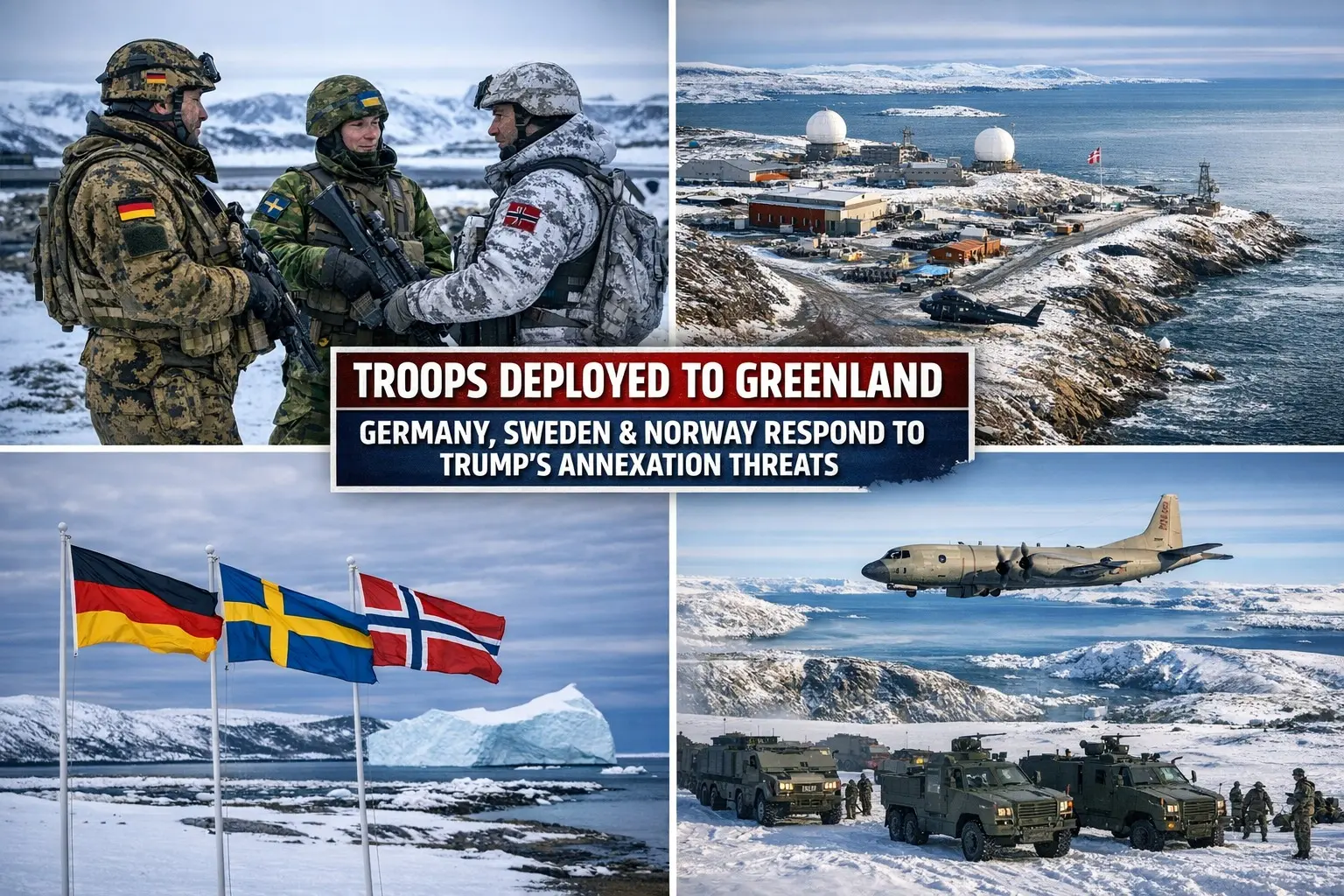
This developing story—whether fully confirmed or not—highlights how sensitive the Arctic region has become amid rising great-power competition.
Why Greenland Matters Strategically
Greenland, an autonomous territory within the Kingdom of Denmark, occupies one of the most strategic locations on Earth. Positioned between North America and Europe, the island plays a crucial role in:
Arctic defense and early-warning systems
Control of emerging Arctic shipping routes
Access to rare earth minerals and natural resources
Missile defense and space surveillance
The United States already maintains a major military presence at Pituffik Space Base (formerly Thule Air Base), which is critical for missile warning and space monitoring. As Arctic ice continues to melt, Greenland’s strategic value has only increased.
Trump’s Annexation Remarks: A Catalyst Revisited
In 2019, Donald Trump drew international attention after publicly floating the idea of the United States purchasing or annexing Greenland. The proposal was swiftly rejected by Denmark and Greenlandic leaders, who emphasized that the island was not for sale.
Although those remarks were made years ago, they continue to resonate today as geopolitical tensions intensify. Analysts argue that even rhetorical threats involving sovereignty can trigger defensive posturing, especially in regions as sensitive as the Arctic.
Recent claims suggest that these past annexation threats are once again being referenced in diplomatic and military discussions across Northern Europe.
Reports of European Troop Deployments
According to unverified reports, Germany, Sweden, and Norway are coordinating troop movements or increasing their military readiness in relation to Greenland. If accurate, this would represent a significant shift in European defense posture in the Arctic.
Each of these countries has a strong strategic rationale:
Norway
As a frontline Arctic and NATO state, Norway has long emphasized Arctic readiness and regularly conducts cold-weather military exercises.
Sweden
Although traditionally neutral, Sweden has significantly increased its defense cooperation with NATO in recent years, particularly in response to regional security concerns.
Germany
Germany has expanded its role in European and NATO security, including logistical support, rapid deployment forces, and Arctic research initiatives.
At this stage, no official NATO statement has confirmed troop deployments to Greenland, and defense ministries have not publicly detailed any such operations.
Denmark and NATO: A Delicate Balance
Denmark, which retains responsibility for Greenland’s defense, finds itself in a particularly delicate position. Any foreign troop presence on or near Greenland would require close coordination with Copenhagen.
From a NATO perspective, Greenland is already part of the alliance’s strategic planning through Denmark and the U.S. However, the involvement of additional European troops—if confirmed—could signal a broader NATO effort to reinforce Arctic deterrence.
Security experts caution that misinterpretation or exaggerated reporting could escalate tensions unnecessarily, especially between NATO and Russia, which has also increased its Arctic military activity.
Russia and China Watching Closely
Any military movement in the Arctic is closely monitored by Moscow and Beijing.
Russia maintains the largest Arctic military footprint, with airbases, radar systems, and icebreaker fleets.
China, while not an Arctic state, has declared itself a “near-Arctic power” and invested heavily in research, shipping routes, and resource exploration.
Even unconfirmed reports of European troop deployments to Greenland could influence strategic calculations by both countries.
Expert Reactions and Analysis
Defense analysts urge caution in interpreting the current situation.
“The Arctic is extremely sensitive to signaling,” said one European security expert. “Even discussions or rumors of troop movements can have strategic consequences. Verification is critical before drawing conclusions.”
Others argue that the reports reflect a broader reality: Arctic security is no longer a fringe issue, but a central pillar of global defense planning.
What This Could Mean for Arctic Security
If the reports eventually prove accurate, the implications could be significant:
Stronger European Role in the Arctic Europe may be moving toward a more active military posture in Arctic defense.
Expanded NATO Coordination Greenland could become an even more integrated hub for NATO’s northern strategy.
Increased Geopolitical Tension Any military buildup risks heightening competition with Russia and China.
Renewed Debate Over Sovereignty Greenland’s political status and future autonomy could come under renewed international focus.
The Importance of Verification
At present, it is essential to distinguish confirmed developments from speculation. While Trump’s past annexation comments are well documented, claims of immediate troop deployments by Germany, Sweden, and Norway have not been officially verified.
In an era of rapid news cycles and viral headlines, readers and policymakers alike are urged to rely on official statements and credible sources.
Conclusion
Whether or not European troops are actively being sent to Greenland, the broader message is clear: Greenland has become a focal point of 21st-century geopolitics. Trump’s annexation remarks—despite being years old—continue to echo in today’s security environment, underscoring how strategic narratives can shape military planning.
As Arctic competition accelerates, Greenland’s role in global security will only grow. The coming weeks may bring clarification, official responses, and potentially new developments that redefine the balance of power in the High North.
For now, the world is watching Greenland—and the Arctic—more closely than ever.