The global humanitarian crisis in Venezuela has long drawn concern from world leaders, activists, and international organizations.
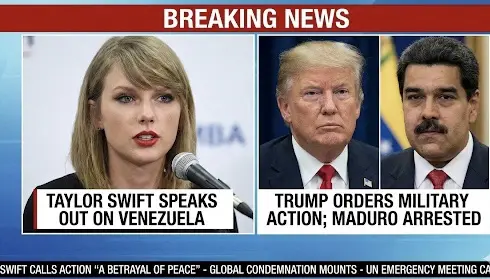
In a surprising development that has ignited intense debate across social media and global news platforms, global music icon Taylor Swift has reportedly spoken out on the Venezuela crisis, strongly condemning what she described as former U.S.
President Donald Trump’s aggressive stance toward the country, including alleged military actions and calls for the arrest of Venezuelan President Nicolás Maduro.
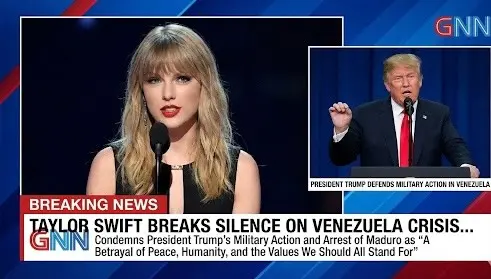
Swift’s remarks, shared through public commentary and widely circulated online, mark one of her most direct interventions into international geopolitics.
Known for her growing political activism in recent years, the superstar framed the situation as “a betrayal of peace, humanity, and the values we should all stand for.” Her statement has resonated with millions of fans worldwide while also drawing criticism from political commentators.
Venezuela Crisis: A Nation in Turmoil
Venezuela has faced years of political instability, economic collapse, hyperinflation, and widespread humanitarian suffering. Shortages of food, medicine, and basic services have forced millions of Venezuelans to flee the country, creating one of the largest migration crises in modern history.
International responses to Venezuela have been deeply divided. While the United States and several allies have imposed sanctions and recognized opposition leadership in the past, others have criticized foreign intervention, warning that military pressure could worsen civilian suffering.
Against this backdrop, discussions around possible military intervention, regime change, or arrest warrants against President Nicolás Maduro have repeatedly surfaced in political discourse—often fueling controversy and fear rather than resolution.
Taylor Swift’s Statement: A Rare but Powerful Intervention
Taylor Swift has gradually become more vocal on political and social justice issues, particularly since 2018. However, her reported comments on Venezuela represent a notable shift from domestic politics to international humanitarian concerns.
According to widely shared excerpts, Swift emphasized that violence and coercion cannot be justified as solutions, regardless of political disagreements.
“Peace cannot be built with threats, arrests, or military force,” Swift stated. “History has shown us that the people always pay the highest price.”
By invoking universal values such as dignity, compassion, and diplomacy, Swift positioned her message not as a partisan attack, but as a moral appeal to global leadership.
Condemning Militarization and Political Arrests
Swift’s criticism focused on what she described as a dangerous normalization of military rhetoric and political arrests in international relations.
While claims surrounding direct military action or the arrest of President Maduro remain heavily disputed and politically charged, Swift argued that even the discussion of such measures reflects a failure of diplomacy.
Human rights organizations have long warned that external military pressure can escalate violence and destabilize already fragile societies. Swift echoed these concerns, calling instead for humanitarian aid, international mediation, and respect for civilian lives.
Global Reaction: Praise, Backlash, and Debate
Unsurprisingly, Swift’s comments triggered a wave of global reactions:
Supporters praised her courage, applauding her willingness to use her platform to spotlight humanitarian suffering.
Critics accused her of overstepping, arguing that celebrities lack the expertise to comment on complex geopolitical issues.
Political analysts noted her influence, pointing out that her statements reached audiences often disengaged from international politics.
On social media, hashtags linking Taylor Swift, Venezuela, and peace trended across multiple platforms, demonstrating the immense reach of celebrity-driven political discourse.
The Power and Responsibility of Celebrity Activism
Taylor Swift’s involvement reignites an ongoing debate: Should celebrities speak out on global political crises?
Supporters argue that celebrities can:
Raise awareness among younger and global audiences
Humanize distant crises
Pressure governments through public opinion
Critics counter that celebrity activism can oversimplify complex issues or unintentionally spread misinformation if not carefully framed.
Swift appeared to address this concern directly, urging her followers to seek credible sources, support humanitarian organizations, and prioritize empathy over ideology.
Diplomacy Over Force: A Call for Global Leadership
At the heart of Swift’s message was a call for renewed commitment to diplomacy. She urged world leaders to abandon language of domination and punishment in favor of dialogue, cooperation, and humanitarian relief.
Her statement aligns with positions held by many international organizations, including the United Nations, which has consistently emphasized peaceful negotiation and civilian protection in Venezuela.
Why Taylor Swift’s Voice Matters
With a fanbase spanning continents and generations, Taylor Swift’s voice carries undeniable influence. Whether one agrees with her perspective or not, her comments have re-centered global attention on the Venezuelan people, rather than purely political power struggles.
In an era where global crises often fade quickly from headlines, Swift’s intervention demonstrates how cultural figures can reignite conversations about human rights, peace, and moral responsibility.
Conclusion
Taylor Swift’s decision to speak out on the Venezuela crisis represents a significant moment in modern celebrity activism. By condemning militarization, political arrests, and the erosion of humanitarian values, she challenged global leaders to reconsider the cost of force-driven solutions.
As debates continue over the role of foreign intervention and international accountability, Swift’s message serves as a reminder that peace, humanity, and compassion should remain at the center of global decision-making—values that transcend politics, borders, and fame.