Protests in Minneapolis escalated dramatically on Tuesday night after demonstrators were seen setting an American flag on fire in response to a recent shooting involving an Immigration and Customs Enforcement (ICE) agent. The incident has intensified national attention on the case, deepened political divisions, and renewed debate over immigration enforcement, police accountability, and the limits of protest in the United States.
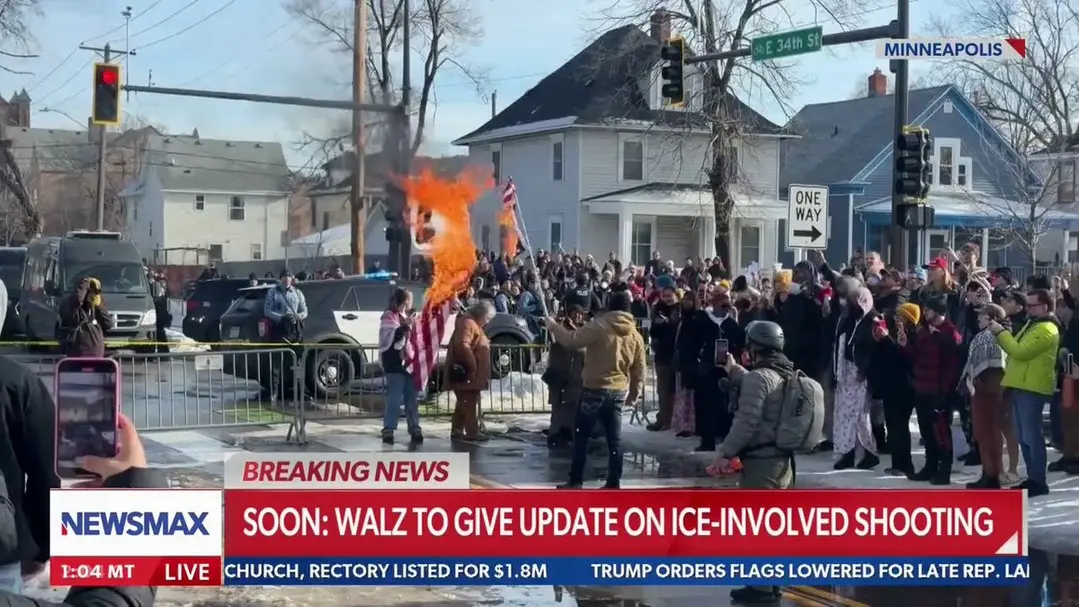
The flag-burning occurred amid ongoing demonstrations sparked by the fatal shooting, which has already drawn condemnation from civil rights groups, lawmakers, and community leaders. Video footage circulating on social media shows a group of protesters igniting the U.S. flag while chanting slogans critical of ICE and federal law enforcement.
Minneapolis protests escalate after ICE shooting
The protests began shortly after news broke of the ICE-related shooting, which resulted in the death of a civilian during an enforcement operation. While authorities have stated that an investigation is ongoing, many residents and activists have expressed outrage, arguing that the use of lethal force was unjustified.
Initially, demonstrations were largely peaceful, with protesters gathering in downtown Minneapolis and near federal buildings to demand accountability. However, as night fell, tensions rose. The burning of the American flag marked a significant escalation and quickly became one of the most widely shared images of the protest.
Local law enforcement confirmed that they were monitoring the situation closely but did not immediately intervene during the flag-burning incident, citing crowd-control concerns and constitutional protections related to free expression.
Symbolism and controversy of flag burning
Burning the American flag is one of the most controversial forms of political protest in the United States. While the act is protected under the First Amendment, it often provokes strong emotional reactions across the political spectrum.
For protesters in Minneapolis, the act appeared to symbolize anger toward the federal government, ICE, and what they describe as systemic injustice within immigration enforcement. Activists argued that the flag burning was a response to what they see as a pattern of unaccountable violence by authorities.
Critics, however, condemned the act as deeply disrespectful, particularly given the flag’s significance to veterans, military families, and many Americans who view it as a symbol of national unity and sacrifice.
Political reactions pour in
The flag-burning incident prompted swift reactions from politicians at both the state and national levels. Conservative lawmakers criticized the protesters, accusing them of exploiting a tragic event to promote anti-American sentiment.
Several Republican officials called for a stronger law enforcement response, arguing that protests involving property destruction or flag desecration risk spiraling into broader unrest.
Democratic leaders, while largely defending the right to protest, urged demonstrators to remain peaceful and focused on accountability rather than symbolic acts that could alienate the broader public. Some emphasized that while flag burning is legally protected, it may distract from calls for justice in the ICE shooting investigation.
ICE shooting fuels broader national debate
The Minneapolis incident is the latest flashpoint in an ongoing national debate over ICE’s role, tactics, and oversight. Immigration enforcement has remained a deeply polarizing issue, particularly in communities with large immigrant populations.
Civil rights organizations have renewed calls for independent investigations into ICE-related use-of-force incidents, arguing that internal reviews are insufficient to ensure accountability. The release of video footage related to the shooting has further intensified scrutiny, with critics saying it raises serious questions about the justification for deadly force.
Supporters of ICE maintain that agents operate under dangerous conditions and must be allowed to protect themselves while carrying out federal law. They warn that public outrage, fueled by incomplete information, could undermine law enforcement operations nationwide.
Law enforcement response in Minneapolis
Minneapolis police stated that they are coordinating with federal authorities to maintain public safety while respecting constitutional rights. Additional officers were deployed to areas where protests were expected to continue, though officials stressed that their goal was de-escalation rather than confrontation.
No immediate arrests were reported in connection with the flag burning, and authorities did not indicate whether charges would be pursued. Legal experts note that Supreme Court precedent clearly protects flag burning as a form of political expression, making prosecution unlikely unless additional crimes occurred.
Public reaction on social media
Images and videos of the burning American flag spread rapidly across social media platforms, triggering intense debate. Hashtags related to Minneapolis, ICE, and the protest trended nationally within hours.
Some users expressed solidarity with the protesters, arguing that dramatic actions are sometimes necessary to draw attention to injustice. Others responded with anger, accusing demonstrators of disrespecting the nation and dishonoring its values.
The polarized reaction underscores how deeply divided public opinion remains on issues of immigration, law enforcement, and protest tactics.
Historical context of protests in Minneapolis
Minneapolis has a recent history of being at the center of national protests related to law enforcement and civil rights. The city became a focal point for global demonstrations following the killing of George Floyd in 2020, and those events reshaped conversations around policing and accountability.
Observers note that the current protests draw on that legacy, with many activists viewing the ICE shooting as part of a broader pattern rather than an isolated incident.
What happens next
As investigations into the ICE shooting continue, Minneapolis officials are bracing for further demonstrations. Community leaders have called for calm while urging transparency and accountability from federal authorities.
Whether the flag-burning incident will shift public opinion or influence the outcome of the investigation remains unclear. What is certain is that the images from Minneapolis have reignited national conversations about protest, patriotism, and justice in America.
For now, Minneapolis remains under intense scrutiny as the nation watches how authorities respond—both to the shooting itself and to the growing wave of protest it has unleashed.