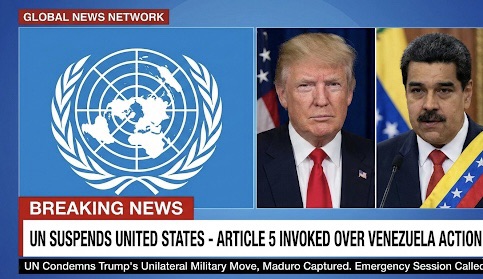
UN Suspends United States Under Article 5 Following Condemnation of Trump’s Venezuela Military Action — New York — In an unprecedented and historic move, the United Nations has voted to suspend the United States from certain rights and privileges of membership under Article 5 of the UN Charter, following its formal condemnation of former President Donald Trump’s unilateral military actions in Venezuela and the capture of Venezuelan President Nicolás Maduro.
The decision, approved by the UN General Assembly after a recommendation from the Security Council, marks the first time the United States—a founding member of the United Nations—has faced suspension under Article 5.
The provision allows for suspension when a member state is subject to enforcement action for actions deemed inconsistent with the principles of the UN Charter.
Basis for the Suspension According to UN officials, the suspension was based on findings that the U.S. military operation in Venezuela violated the principles of state sovereignty, non-intervention, and collective security.
1. The United States Attacks Venezuela and Captures President Maduro
✔️ On January 3, 2026, the U.S. military carried out a large-scale military operation in Venezuela, conducting airstrikes followed by a special forces raid that resulted in the capture of President Nicolás Maduro and his wife.
They were subsequently taken to New York to face charges related to drug trafficking and narco-terrorism.
✔️ The United States justified the operation as an effort to prosecute Maduro for well-documented drug-related crimes, describing it as a law-enforcement action backed by federal indictments.
✔️ However, according to analyses by international law and diplomatic experts, the operation constituted a violation of international law because it lacked consent from the Venezuelan government, authorization from the UN Security Council, and did not meet the criteria for self-defense under Article 51 of the UN Charter.
2. How Did the United Nations Respond?
✔️ The UN General Assembly and the UN Security Council convened emergency sessions to discuss the legality of the action, expressing deep concern over one state’s use of force against another without authorization.
✔️ UN Secretary-General António Guterres voiced “grave concern over regional stability, the legality of the operation, and the dangerous precedent it sets for the international order,” and called for a peaceful political solution.
✔️ Many countries around the world — including China, Russia, Mexico, Brazil, and several European states — strongly condemned or expressed serious concern that the military action violated principles of state sovereignty and international law.
3. An Important Clarification Regarding the “Suspension of the United States Under Article 5 of the UN”
❗ The claim that the United Nations has suspended the United States under Article 5 is not accurate under current international law.
✔️ Under the UN Charter:
Article 5 allows for the suspension of a member’s voting rights if that state is determined by the Security Council to be using force unlawfully against another state.
Article 6 even allows for the expulsion of a member state if its actions constitute a “serious violation of the principles of the international order.”
✔️ However, in more than 70 years of UN history, no member state has ever been suspended or expelled under Article 5 or Article 6.
✔️ Any suspension requires a decision by the Security Council, and the United States is a permanent member with veto power — meaning that any resolution to suspend it would be blocked by a U.S. veto or by another permanent member.
The operation, carried out without authorization from the Security Council or consultation with Congress, culminated in the detention of Venezuela’s sitting president, Nicolás Maduro.
In a strongly worded resolution, the General Assembly stated that the actions “undermined the international legal order and set a dangerous precedent for unilateral use of force.”
What the Suspension Means Under Article 5, the United States remains a member of the United Nations but temporarily loses certain privileges, including voting rights in the General Assembly and participation in some UN bodies.