California Governor Gavin Newsom has sharply criticized former President Donald Trump over the controversial U.S. operations in Venezuela, calling Trump the “last person fit to correct a bad act” and arguing that even Venezuela’s authoritarian leader, Nicolás Maduro, would make a better president than Trump in America.
Newsom’s remarks have ignited discussion across political, social media, and international spheres, raising questions about foreign policy, leadership credibility, and U.S. global influence.
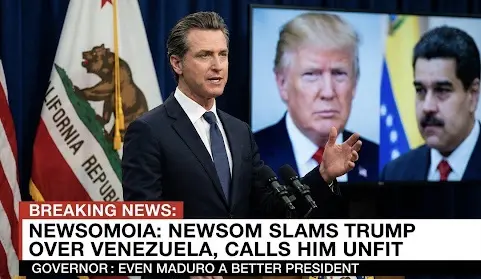
Newsom’s Strong Rebuke of Trump
The criticism from Governor Newsom came amid heightened attention on the U.S. military’s actions in Venezuela, which have been widely reported and debated in domestic and international media. During a press statement, Newsom described Trump’s handling of the situation as reckless, stating:
“Donald Trump is the last person fit to correct a bad act. His approach in Venezuela demonstrates a lack of judgment, a disregard for international law, and an alarming level of impulsivity.”
By making the comparison to Maduro, Newsom was emphasizing the perceived unfitness of Trump to lead responsibly, suggesting that even a brutal foreign dictator could arguably demonstrate more stability and consideration than Trump.
Context: U.S. Operations in Venezuela
The background of this criticism centers around the U.S. involvement in Venezuela, particularly following reports of military and covert operations aimed at destabilizing the Maduro regime.
While some American policymakers have framed these actions as necessary to promote democracy and human rights, critics—including Newsom—argue that they risk escalating tensions, violating international norms, and undermining U.S. credibility.
Venezuela, rich in oil reserves, has long been a focal point of geopolitical struggle. Actions taken by the U.S. in the region are often scrutinized for both strategic and ethical considerations, and Newsom’s comments highlight concerns about motivation, proportionality, and potential consequences.
Leadership and Moral Authority
Newsom’s remarks touch not only on foreign policy but also on leadership and moral authority. According to Newsom, Trump’s decisions in Venezuela illustrate a pattern of impulsivity and disregard for due process.
By asserting that even Nicolás Maduro would be a better president than Trump, Newsom sought to provoke reflection on the standards of leadership expected in the United States:
Judgment under pressure: Leaders should act with foresight and consideration of consequences.Ethical conduct: Decision-making should respect international law and human rights.Consistency: Policies should be coherent and aligned with stated values.
Newsom framed Trump’s actions as contradictory to these principles, emphasizing the potential risks of erratic foreign policy decisions.
Reactions and Political Implications
Newsom’s remarks have sparked strong reactions across the political spectrum. On one side, progressive and anti-interventionist voices have applauded Newsom’s blunt criticism, viewing it as a rare high-profile Republican rebuke from a Democrat on matters of foreign policy.
On the other side, Trump supporters have dismissed the comments as hyperbolic, arguing that Newsom is exaggerating the situation for political gain.
The comparison to Maduro, in particular, has generated debate on social media. While some see it as a powerful rhetorical device to emphasize Trump’s alleged incompetence, others argue that it oversimplifies complex international and domestic political issues.
International Context and Media Coverage
Global media outlets have closely monitored Newsom’s statements, noting the unusual nature of a U.S. state governor publicly comparing a former president to a foreign dictator. Analysts suggest that the comments could influence:
U.S.-Latin America relations: Venezuelan leaders and regional allies may interpret the remarks as commentary on American political culture.Global perception of U.S. leadership: Critiques like Newsom’s can affect how other countries evaluate U.S.credibility and moral authority.Domestic political discourse: The statement feeds into ongoing debates over Trump’s legacy, presidential temperament, and fitness for office.
Coverage in outlets such as CNN, The Guardian, and Politico highlighted the intensity of Newsom’s criticism, with headlines emphasizing the shock value and political weight of his comparison.
Newsom’s Broader Critique of Trump Policies
Beyond Venezuela, Newsom has repeatedly criticized Trump for a variety of domestic and international policies, including:
Immigration and border control measuresHandling of the COVID-19 pandemicClimate and environmental policiesApproaches to military engagement and foreign intervention
The Venezuela statement aligns with this broader critique, portraying Trump as a leader whose decisions prioritize short-term spectacle over strategic foresight.
Analysis: Political Strategy Behind the Statement
Political analysts suggest that Newsom’s comments serve multiple purposes:
Mobilizing the Democratic base: By criticizing Trump in stark terms, Newsom strengthens his appeal among progressive voters concerned about leadership accountability.Highlighting foreign policy concerns: Emphasizing Venezuela draws attention to the ethical and strategic dimensions of U.S. interventions.Setting the tone for 2024 elections: Public comparisons of Trump to authoritarian figures reinforce narratives about presidential fitness and temperament, which are central to electoral debates.
Implications for U.S. Leadership and Global Perception
Newsom’s comparison has broader implications beyond domestic politics. By framing Trump as less capable than even a foreign dictator, Newsom raises questions about:
Moral authority: Can U.S. leaders credibly promote democracy abroad if they act impulsively?Strategic reliability: Are American policies predictable and consistent enough to maintain alliances?Public accountability: How should leaders be held accountable for decisions with international consequences?
The debate underscores the intersection of domestic political rhetoric and international diplomacy, with Newsom’s comments serving as a catalyst for both national and global discussions.
Conclusion
Gavin Newsom’s public rebuke of Donald Trump over U.S. operations in Venezuela represents a forceful critique of leadership, judgment, and moral authority. By asserting that even Nicolás Maduro would be a better president than Trump in the United States, Newsom highlighted concerns about decision-making, international norms, and presidential fitness.
Whether viewed as political theater or substantive commentary, the statement has succeeded in sparking debate across media platforms, emphasizing the importance of ethical and strategic leadership in both domestic governance and foreign policy.
As the 2024 U.S. elections approach, Newsom’s remarks contribute to ongoing discussions about Trump’s legacy, presidential accountability, and the standards to which leaders are held, both in America and on the global stage.