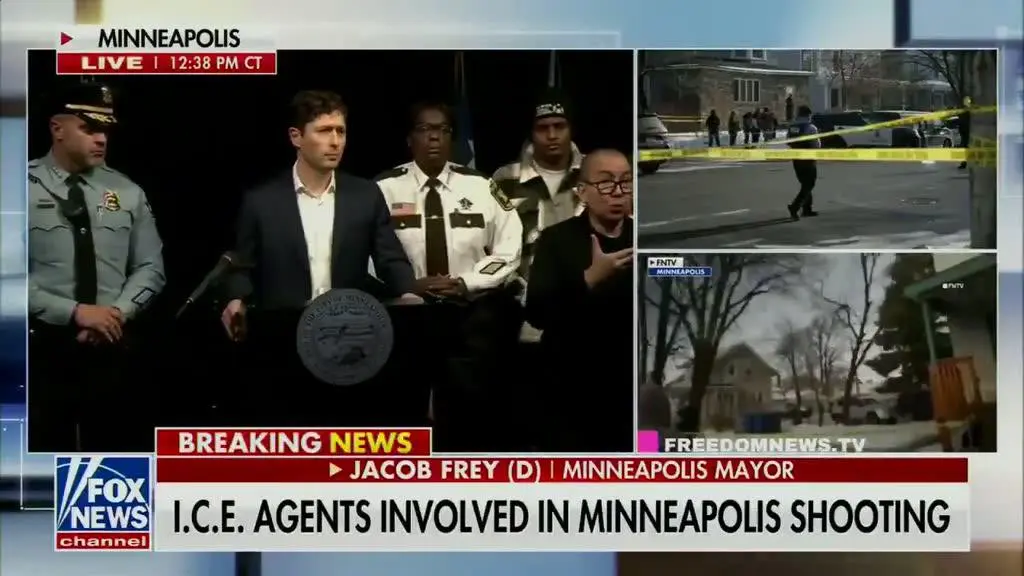
In a dramatic escalation of tensions between local authorities and federal immigration enforcement, Minneapolis Mayor Jacob Frey delivered a forceful message following a fatal shooting involving U.S. Immigration and Customs Enforcement (ICE) agents. Speaking on camera, Frey did not mince words, demanding that federal agents leave the city entirely, signaling a rare and highly public confrontation between municipal leadership and a federal law enforcement agency.
This incident has ignited nationwide debate about policing, immigration enforcement, and accountability in cases of lethal force.

The Fatal Shooting Incident
The events leading to Mayor Frey’s fiery statement began when ICE agents were involved in an operation that ended in the death of a Minneapolis resident. Details are still emerging, but multiple sources indicate that the victim was unarmed at the time of the shooting, sparking immediate public outrage.
Witnesses reported chaotic scenes as first responders arrived, with residents expressing fear and anger over the use of deadly force by federal agents in a densely populated urban area. Law enforcement experts emphasize that any operation involving federal immigration authorities carries heightened risks, particularly when local community relations are already strained.
Mayor Frey’s Response
Mayor Jacob Frey appeared on camera shortly after news of the shooting broke. His statement was pointed and unequivocal:
He condemned the use of lethal force in a residential community.He criticized ICE for operating in Minneapolis without sufficient local oversight.He demanded that federal agents “get the f out”* of the city, framing the incident as part of a broader issue of accountability and respect for local governance.
Frey’s statement has been interpreted by many analysts as a direct challenge to federal authority and a signal that Minneapolis will no longer tolerate unregulated operations by ICE within city limits.
Historical Context: ICE and Local Tensions
Minneapolis has a long history of strained relationships between federal agencies and local authorities, particularly around immigration enforcement. In recent years, several incidents have heightened scrutiny of ICE operations:
Allegations of racial profiling and disproportionate targeting of immigrant communities.Controversial raids in public spaces, including schools and community centers.Tensions between local “sanctuary city” policies and federal immigration mandates.
Mayor Frey’s outspoken criticism reflects a growing frustration among city leaders across the country who feel that federal enforcement actions often disregard local laws, community safety, and human rights.
Public Reaction and Community Impact
The shooting has prompted widespread protests and calls for accountability. Residents, activists, and advocacy groups have taken to the streets, demanding:
A full investigation into the shooting.Transparency regarding ICE’s role and decision-making process.Greater oversight of federal agents operating in Minneapolis.
Social media has amplified these concerns, with hashtags calling for justice for the victim and demanding ICE accountability trending nationally. Community leaders stress that incidents like these erode trust in both federal and local law enforcement, making it harder to maintain public safety.
Federal Response and ICE Statement
ICE has issued a brief statement acknowledging the incident but has so far avoided providing detailed information about the operation or the circumstances of the shooting. The agency reaffirmed its commitment to “lawful enforcement” but did not directly respond to Mayor Frey’s demands.
Political analysts note that ICE rarely faces public rebuke from city officials at this level, making Minneapolis’ position unusual. The confrontation raises questions about the limits of federal authority when operating within cities with strong local governance structures.
Legal Implications
The incident could have significant legal consequences for multiple parties:
Families of victims may pursue civil rights lawsuits against ICE agents and the federal government.The city of Minneapolis may explore policy changes or restrictions on federal operations within city limits.National attention could trigger congressional oversight hearings to examine federal enforcement protocols and accountability.
Legal experts warn that lethal encounters between federal agents and civilians in urban areas can trigger lengthy litigation, high-profile investigations, and policy reforms.
Political Fallout
Mayor Frey’s comments come amid heightened political sensitivity around immigration enforcement and policing. Analysts suggest that:
Democrats and progressives may view Frey’s stance as protective of local communities and immigrant rights.Conservatives and federal authorities may see his comments as undermining law enforcement and national security priorities.The incident could fuel debate over sanctuary cities and federal preemption, especially in cities with large immigrant populations.
The political consequences of this confrontation may reverberate into national debates, particularly ahead of upcoming elections where immigration and public safety remain top issues.
National Debate on ICE Operations
This Minneapolis incident has reignited a broader national debate about the role of ICE in U.S. communities. Key points include:
Whether federal agents should be allowed to operate independently in cities with local restrictions.The balance between enforcing federal immigration laws and protecting community safety.How to ensure accountability for lethal force used by federal officers.
Advocates for reform argue that incidents like these demonstrate a need for greater transparency, stricter oversight, and accountability mechanisms to prevent future tragedies.
What Happens Next
As investigations continue, several questions remain:
Will ICE comply with Mayor Frey’s demand to leave Minneapolis?How will federal authorities respond to the political and legal pressure?What changes will Minneapolis implement to protect its residents while balancing federal law enforcement obligations?
The coming weeks are likely to involve intense negotiations between city officials, federal authorities, and community leaders, as well as potential legal and legislative developments at both the state and national levels.
Conclusion
The fatal shooting in Minneapolis and Mayor Jacob Frey’s subsequent demand that ICE “get the f* out” marks a historic escalation in local-federal tensions. It highlights critical questions about accountability, community safety, and the role of federal law enforcement in American cities.
As public outrage grows and investigations continue, Minneapolis may become a national focal point for debates over immigration enforcement, policing, and municipal autonomy.
The unfolding events will have lasting implications for the city, federal agencies, and the broader conversation about how America balances law enforcement with human rights and community trust.
This incident is not just a local crisis—it is a national story with legal, political, and social ramifications that will shape the future of ICE operations in cities across the United States.