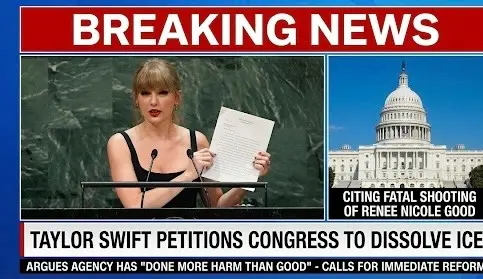
In a stunning political development, global pop icon Taylor Swift has submitted a formal petition to the U.S. Congress calling for the immediate dissolution of the U.S. Immigration and Customs Enforcement (ICE) agency.
According to the petition text, Swift cites the recent fatal shooting of Minneapolis resident Renee Nicole Good during an ICE enforcement operation as a key reason for her demand, asserting that the agency has “done more harm than good” to American communities.
While Swift’s involvement marks an unusual and high-profile entry into a contentious political issue, the underlying controversy stems from an incident that has triggered national outrage, protests, and renewed debate about federal immigration enforcement.
The Minneapolis Shooting That Sparked National Outrage
On January 7, 2026, 37-year-old Renee Nicole Good, a Minneapolis resident, mother of three, poet, and community member, was fatally shot by an ICE agent during a large federal immigration enforcement operation in south Minneapolis. According to official accounts, the ICE officer fired his weapon after Good’s vehicle began moving in the vicinity of agents — a claim the federal government says justified lethal force. Local officials and witnesses, however, dispute parts of that narrative, prompting deep public skepticism.
The incident has become a flashpoint in debates over ICE tactics and accountability, particularly after video footage of the shooting circulated online showing conflicting sequences of events. Minneapolis Mayor Jacob Frey condemned the operation and urged ICE to leave the city, saying that the agency’s presence has “caused chaos and distrust” in local communities.
Taylor Swift’s Petition: A Pop Star Takes a Stand
Amid widespread protests and political pressure, Taylor Swift reportedly submitted a formal petition to lawmakers demanding the dissolution of ICE as a federal agency. In the petition, Swift argues that ICE’s actions, especially the deadly shooting of Renee Good, reflect systemic problems that cannot be resolved through reform alone.
She asserts that the agency’s history of controversial enforcement practices and use of force has done “more harm than good” and eroded trust between communities and law enforcement.
Swift’s petition has gained rapid attention on social media and in political circles. It urges Congress to pass legislation that would disband ICE and replace federal immigration enforcement with new structures emphasizing accountability, restraint, and community safety.
Protests and Political Reaction Across the U.S.
Swift’s petition comes as protests related to the shooting continue nationwide. Thousands of demonstrators in Minneapolis and other cities have taken to the streets to denounce ICE, demand justice for Renee Good, and call for major changes to federal immigration policy. Cities including Boston, New York, Austin, and Philadelphia have seen rallies under banners like “ICE Out For Good”, where protesters condemn the agency’s actions and argue that the Minneapolis incident reflects a broader pattern of excessive force.
These demonstrations, largely organized by grassroots groups, civil rights activists, and community organizers, highlight the depth of public anger and the desire for systemic change. Some protests have remained peaceful, focusing on vigils and speeches, while others have seen clashes with law enforcement and temporary arrests — demonstrating the emotional and political intensity surrounding the issue.
Lawmakers Respond: A Polarized Political Landscape
The reaction among lawmakers to Swift’s petition and the broader movement has been sharply divided along party lines. Democratic legislators sympathetic to immigration reform have praised the petition as a bold statement and urged Congress to take the concerns seriously.
Some members of Congress are calling for hearings and closer scrutiny of ICE use-of-force policies, while others have expressed openness to reimagining how federal immigration enforcement should operate.
Republican lawmakers defending ICE argue that the agency plays an essential role in national security and border protection. They caution against dismantling ICE entirely, calling such proposals politically motivated and potentially harmful to law enforcement effectiveness.
The debate over the petition reflects broader national divisions on immigration policy, policing powers, and federal oversight — divisions that have only grown more intense after the Minneapolis shooting.
Why the Renee Good Shooting Resonated Nationwide
Public reaction to the Minneapolis incident has been fueled by several factors:
The tragic circumstances of the shooting — a U.S. citizen killed during a federal operation.Conflicting accounts of whether deadly force was justified.Memories of previous Minneapolis tragedies — including the murder of George Floyd by local police in 2020 — which have made the community particularly sensitive to law enforcement violence.
These elements helped transform a local incident into a national story, and the involvement of high-profile figures like Taylor Swift has elevated its visibility even further.
Swift’s Influence and the Power of Celebrity Activism
Taylor Swift is no stranger to using her platform to speak on political and social issues, but this move represents one of her boldest forays yet into highly charged federal policy debates.
Swift’s petition — whether or not it leads to actual legislative change — is expected to sharpen public dialogue around ICE, immigration enforcement, and the role of celebrity voices in shaping political discourse.
Analysts say Swift’s involvement may drive greater engagement among younger voters and mobilize communities that previously felt disconnected from these issues. Critics, however, argue that celebrity interventions oversimplify complex policy questions and risk polarizing already fraught debates.
What Happens Next?
The clock is now ticking on how Congress responds to Swift’s petition. If lawmakers decide to take up discussions about ICE’s future, it could lead to:
Congressional hearings on ICE policies and use of force.Legislative proposals to reform, restructure, or replace parts of the agency.Increased public and media scrutiny of federal immigration enforcement practices.
At the same time, conservative lawmakers are likely to push back strongly against any efforts to dismantle ICE, framing such proposals as dangerous and destabilizing.
Whether Taylor Swift’s petition becomes a catalyst for action or remains a symbolic act of protest, it has already drawn national attention to key questions about accountability, governance, and the balance between security and civil rights.
Conclusion
Taylor Swift’s formal petition to Congress demanding the dissolution of ICE — driven in part by outrage over the fatal shooting of Minneapolis resident Renee Nicole Good — has thrust immigration enforcement policy into the national spotlight.
The incident that sparked widespread protests and community grief has now become a rallying point for broader demands for systemic change.
As lawmakers, activists, and residents continue to debate the future of ICE, America faces difficult questions about law enforcement, civil liberties, and the role of federal agencies in local communities.
Swift’s intervention may not be the final answer, but it has undoubtedly amplified the call for accountability and reform in Washington and beyond